

Online pharmacies are no longer a moonshot, but a proven service vertical. The question isn’t whether they will succeed, but how we can strategically participate in a space that our clients accept and increasingly expect.
Veterinary Online Pharmacies Help Your Realize Your Client, Patient, and Business Goals
Today’s veterinary pharmacies are so much more than third party businesses. Modern vet pharmacies like Koala partner with veterinary hospitals to divert clients away from sites like Chewy or PetMeds, dramatically increase client compliance, and provide pet owners the savings and convenience they increasing expect.
Modern veterinary pharmacies can:
- Bring prescription requests into one place. Requests—including those destined for Chewy or Walmart—can be reviewed and managed through one account. No more searching through several communication channels to learn what your clients need.
- Put their human staff to work on your behalf. Trained representatives reach out to clients and encourage them to purchase medications affordably through your hospital’s online store. Instead of losing that business to a retail giant, you have someone helping you keep it.
- Improve compliance with prescription diets and preventatives. Convenient ordering, refill reminders, and automatic shipments help clients follow through on your recommendations.
- Provide the home delivery clients have grown accustomed to. Make getting their pets’ medications fit more easily into their lives.
- Grow recurring revenue with minimal upfront investment. Your business earns income without purchasing and stocking every product you sell.
- Free up valuable capital that would otherwise sit idly on inventory shelves. Less cash tied up in stock improves cash flow. Lower inventory expenses and stronger earnings can also increase practice value.
- Reduce the payroll spent managing inventory. Fewer hours ordering, receiving, counting, and chasing down special requests means more time for client service and patient care.
- Expand the variety of products you offer without additional inventory investment. Give clients more options without finding more shelf space or tying up more cash.
- Extend the reach of your human service team. Trained pharmacy representatives help your hospital stay on top of patients’ prescription needs. Fewer dropped communications and better follow-through help you achieve your loftiest service goals—and make your team look like superstars.
Improve Adoption of Your Online Pharmacy
Whether you are launching a store or improving one you already have, a good intention needs a plan. I use a seven-step approach called the Follow-Through Formula:
- Clarify the purpose. Explain why the initiative matters to the business, clients, pets, and employees, and how it supports your mission.
- Plan the work. Map the client experience from recommendation through ordering, delivery, refills, and follow-up.
- Assign ownership. Name the individuals responsible for each step. “Reception will handle it” leaves too much room for everyone to assume someone else is doing the job.
- Provide training. Give people the knowledge, practice, and language they need to succeed.
- Create a feedback loop. Share results and ask where the process is working, stalling, or creating confusion.
- Build the habit. Put prompts into existing routines so the service is offered consistently.
- Respond thoughtfully. Your reaction to success or setbacks can strengthen the team’s commitment or discourage its next attempt.
Start with the first step. If the team hears only “We need more online sales,” it may interpret the initiative as another production demand. If it understands how the service helps clients care for their animals, the work has a reason behind it.
Give people a reason to care: intrinsic versus extrinsic motivators
I often describe intrinsic motivators as things that pull us toward the work: accomplishment, learning, satisfaction, and the pleasure of doing something well. Meaning, belonging, and having a voice in the process can also help people make a goal their own.
Extrinsic motivators come from outside the task: money, prizes, gift cards, time off, or the consequences of failing to meet a target.
Think about your own hospital. Which cohort is the source of more sustained motivation? Which cohort do you give out more frequently?
Don’t get me wrong, extrinsic motivators work, just not as powerfully or for such a sustained period of time as intrinsic motivators. Mentally explore your own experience with using both or reflect upon the time you used one or the other to train your dog. Yes, the dog responds to a treat, but is the dog really working for the treat or is she more engaged by the relationship she has with you during the training and demonstrating her mastery over the task she has learned?

Example: Intrinsic versus extrinsic motivators
A Hospital Decides on the Best Messaging for Its Initiative
Consider an illustrative hospital: Oceanside Veterinary, a low-cost, high-volume practice in Mississippi. Many of its clients struggle to maintain heartworm prevention. The hospital sees heartworm-positive dogs regularly, some seriously ill.
An advisor suggests exploring an online option that allows clients to purchase individual doses on a recurring schedule. All of the following are true about partnering with an online pharmacy, but which would be best to underline to the staff?
- “Oceanside says we deliver expert care. Partnership with the right online pharm greatly strengthens the consistency of oversight of care for pets. We look like who we want to be.”
- “A study showed that clients purchased 140% more FTHW doses than those that didn’t.”
- “Using the online pharmacy means that we divert traffic away from Chewy and capture that revenue for ourselves.”
- “This goal represents who we are as a hospital and as a team.”
- “Roger, that Pit Bull we saw last week, died at age 6 because his owners said they couldn’t afford the meds. I think this goal should be for Roger.”
- “We run on very tight margins. Carrying fewer products on our shelves, improves cash flow and practice value.”
- “Every client you meet is a chance for you as an individual to make a difference. Our pharmacy is another tool. Use it when you see an opportunity to help.”
- All of the above statements are true, but it’s the first which instills a sense of mastery to team members, ‘I am part of something great.’
- The second also has impact; it offers team members meaning, ‘Lots of hospitals have mission statements, but we live ours.’
- Four gives the team a sense of connection to the mission, belonging, ‘I am part of a committed team.’
- The fifth is powerful as well, working for Roger shows staff members their work has meaning, ‘We don’t work for production, we work for patients.’
- Finally, the last one frames the goal as something everyone can participate in, regardless of employee class or tenure. Everyone has the autonomy to achieve this goal, ‘My job is to scan our clients for opportunities to help and to offer the online pharmacy as one of the tools that could make a difference.’
Let the team identify the benefits
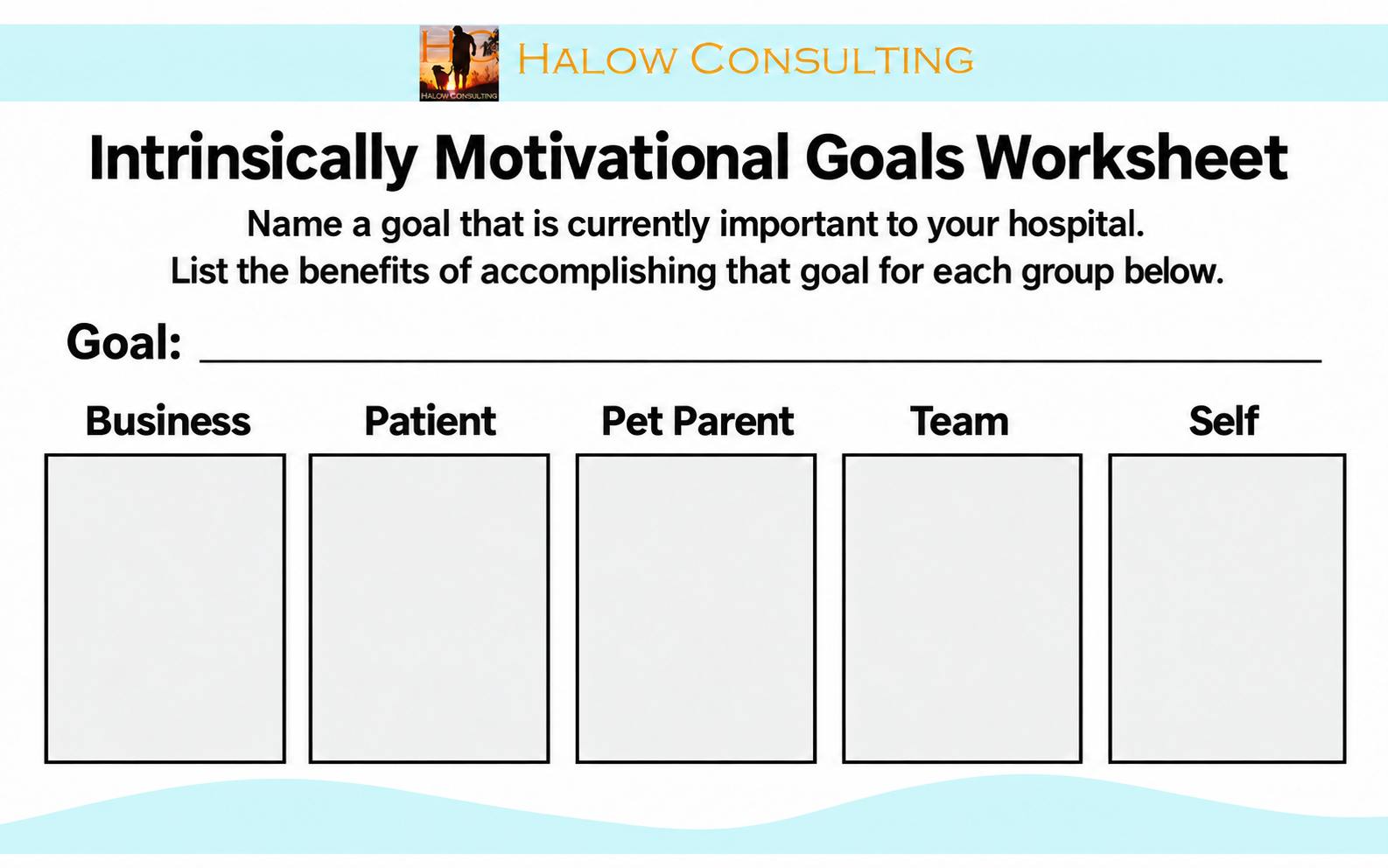
Before handing out assignments, ask employees to explore what a better pharmacy experience could mean for the business, the patient, the pet parent, the team, and themselves. Each perspective offers a reason to care.
For the business, an integrated pharmacy demonstrates proactive oversight of chronic illnesses, prevention, and dietary needs. Helping clients navigate the cost and logistics of treatment strengthens our reputation as a healthcare team concerned about their access to care. At Oceanside, that might sound like: “We work with families to find a manageable way to keep their pets protected.”
For the patient, reliable access to the next supply of medication can help reduce gaps in treatment. Home delivery, online refill ordering, and clear communication can support more consistent care. Human pharmacy research supports improved refill adherence through automatic refill programs.[2] Our veterinary goal is to make it easier for clients to maintain prescribed treatment, heartworm and tick prevention, and therapeutic diets, while continuing to check that those products are appropriate and being used correctly.
For the pet parent, this is an opportunity to show that we listen. Clients regularly tell us that time and price affect their decisions. Some want fewer errands; others want a smaller purchase they can manage within their budget. Where a product’s availability and total delivered price make it practical, an online option can meet those needs. A pharmacy partner vetted by the hospital also gives us a service we can confidently explain and help clients use.
For the team, this is a chance to collaborate across departments on a goal central to our identity as a healthcare team. Doctors, technicians, assistants, receptionists, and managers can all contribute. An efficient fulfillment process can also reduce time spent on transactions and repetitive administration, allowing more attention to client service, medicine, and ongoing patient care.
For each individual, it is a chance to connect with clients, learn something about their lives, and offer a meaningful solution. You do not need a particular degree or years of experience to listen to someone explain that money is tight, that getting back to the hospital is difficult, or that managing refills has become another burden. Clinical recommendations belong with the appropriate medical professionals, but every team member can recognize a need, introduce an available service, and help the client take the next step.
That is an opportunity to shine regardless of your role. It gives employees a voice in improving care and a way to see the value of their own contribution. When administrative work becomes easier, they can use the time recovered for more personal, client-facing work.
Have team members contribute examples from their own conversations. Ask: “What needs do our clients describe? Which could our online pharmacy help address? What would a successful outcome mean to you?” Their answers may be more persuasive than a manager’s carefully prepared speech.

You may also reach out to Koala directly: lorraine.kraus@koala.health
Make ordering through your hospital a natural part of care
Use signage to promote your pharmacy
But pay attention to three details
- Place the signage where people can see if while sitting and waiting, either in the lobby or in the exam room.
- Ensure the copy speaks to what the client wants, not what you want the client to do. In other words, don’t provide a QR code and tell them to sign up. Provide a QR code and tell them if they click through it, they’ll learn how to have more affordable, convenient access to their pet’s medications.
- Consider signage that makes things simple, a 1, 2, 3, illustrated step process for how to access the online store and sign up.
Have techs create a list of medications during the hx process
But cross check this information against their online pharmacy account and work with an open account in the exam room to discuss current medications or issue refills. .
Flag food, FTWM meds, and prescriptions for chronic illness
Put an alert in the software, that shows up at invoicing, to ask clients about auto shipment for any chronic med, food, or preventative.
Run a report on all chronic meds/foods.
Send out an eblast/text message that auto shipment is now available with a link to your site, or better still, pass this information onto your online pharmacy so that they can do this follow through work!
Sign up clients as part of puppy and kitten kit review
Have techs assist clients in the room with understanding the site as they review meds.
Share feedback in intrinsically motivational terms
- “By my estimation, compliance has improved by…”
- “Because of your efforts x% more patients were diverted away from sites where we have no quality control of the meds they receive.”
Check in with individuals: Team members are inexperienced making recommendations.
-
- Ask good questions: “Sometimes when I talk to clients about the pharmacy, I feel like they don’t want to hear it. Does that ever happen to you? How do you handle it?
- Learn together: “After our discussion, I ran across this article on the Koala site. I think it’s worth a read. What do you think about it?”
- Recognize progress: “You’re trying to give our clients affordable access to safe meds and convenience. If you feel you are making the recommendation to use the pharmacy in earnest, you’re honing your communication skills and achieving our goal: showing clients we care.
Pay attention to your reaction to progress, setback, or failure
How you respond to the team’s progress if critical. Here are some considerations:
- Learn before you react
- Demonstrate what positive reactions to failure should look like.
- Emotional intelligence
- Accountability
- Eagerness to improve
- Resilience
- indomitability
Get Started
Remember the following and then reach out for any additional help you might need
- Online pharmacies are already part of how clients shop. The question is no longer whether to offer home delivery and auto-ship. It’s which partner fits your hospital—and how you’ll make ordering through your practice a natural part of client care.
- Clients don’t bleed off to Chewy or Walmart because they don’t like you; they do so because your competitors are listening to what clients need: convenience, price, ease of service, variety, practice communication and oversight.
- Cultivate a relationship with a quality pharmacy that isn’t just a separate third party, but and extension of your service and team.
- As a business decision, online pharmacies
- Drives sales, lowers costs, improve compliance and increase client access to meds
- Improve your hospital’s value
- Free up staff time to focus on veterinary services and patient care
- Launch the initiative to improve using the follow through formula.
Sources
- Nichelason AE et al. “Convenience and price drive online pharmacy usage by veterinary clients.” JAVMA, 2024. https://pubmed.ncbi.nlm.nih.gov/39094628/
- “Community pharmacy automatic refill program improves adherence to maintenance therapy and reduces wasted medication.” Human pharmacy research, 2015. https://pubmed.ncbi.nlm.nih.gov/26633252/
- Cerasoli CP, Nicklin JM, Ford MT. “Intrinsic motivation and extrinsic incentives jointly predict performance: a 40-year meta-analysis.” Psychological Bulletin, 2014. https://pubmed.ncbi.nlm.nih.gov/24491020/
- Koala Health: https://www.koala.health/support ; https://www.koala.health/clinics/support ; https://www.koala.health/auto-refill