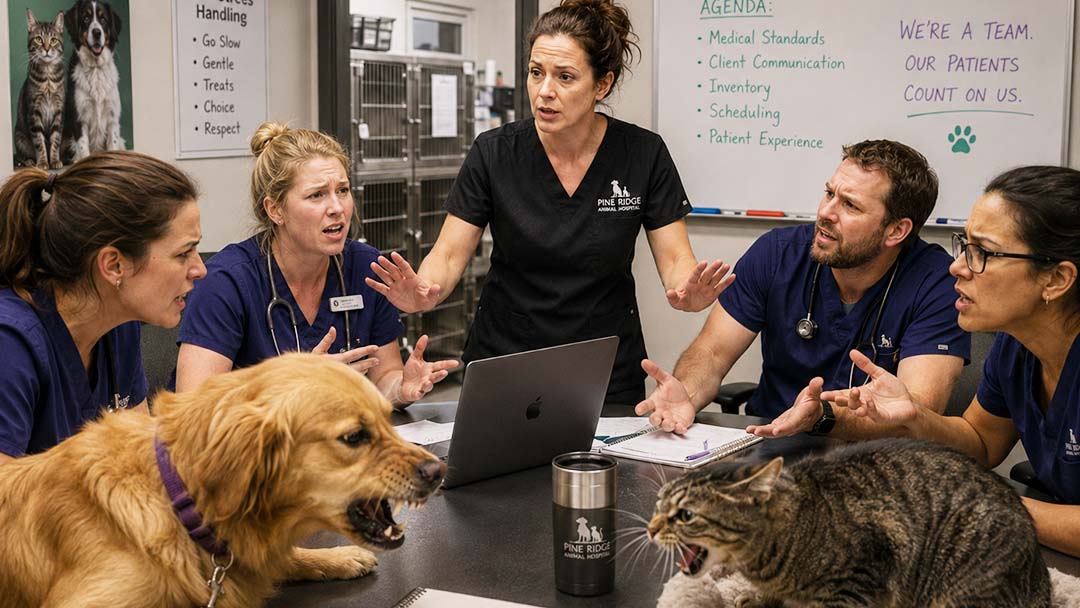
There comes a point in almost every manager’s career when she looks around the room and thinks, “This meeting has completely gone off the rails.”
What began as a discussion about scheduling, patient care, workflow, or a new initiative has devolved into finger-pointing and frustration. Reception is upset with technicians. Technicians are frustrated with doctors. Doctors are irritated with management. Before long, it feels as though the whole staff is rising up in revolt. It’s a coup!
The instinct of many managers is to regain control. Redirect the discussion. Encourage people to “stay positive.” Ask everyone to focus on solutions instead of problems. That’s unlikely to work. When employees feel like griping, they don’t want an answer, they first want acknowledgement. That’s why, “Don’t walk through my office door with a complaint unless you’ve got an idea for a solution’ almost never works. Teams that want to hijack your meeting with complaining are an expression of a team that needed to be heard long before today’s pizza fueled pow wow and trying to put a lid on this tumult is not only unlikely to fix it, it may make it worse.
Complaints Are Organizational Data
When meetings increasingly become complaint sessions, managers often assume they have a meeting problem or a problem with a handful of employees that are stuck in perpetual complaint mode. More often, they have an organizational problem. People rarely spend valuable meeting time complaining because they enjoy it. They complain because something is getting in the way of doing work they care about. Here are the top four reasons:
- Lack of recognition: Up to this point, they feel their efforts, trials and tribulations. have gone unrecognized. They have important information to share about the workplace yet they consistently feel their perspective is dismissed or not taken seriously.
- Unfair work environment: They believe the work environment is unfair and that expectations aren’t applied consistently.
- Incivility: There is another department, group, or single powerful individual in the hospital (usually a doctor or head tech) that is creating obstacles and that are making other jobs unnecessarily difficult. Worse, these complaining individuals don’t know how or simply don’t have the courage to address matters on their own, hence they do it when an authority figure like you is present before they cut loose. The complaint session usually starts out something like, “What if we are trying to check people in faster, but certain doctors insist that we do it the old way?”
- Staff members are afraid to tell leaders that they are the problem. Employees have a message to the leadership in the hospital, but they are afraid to express it or leaders seem perpetually unwilling to take what employees have to say to heart (‘Nothing changes around here.’) So, the team members wait till they have the support of all of their peers before they open their mouths. Strength in numbers. This can often look like a hospital where leaders want change, but who fail to see how they themselves are the thing that needs to change first! Think of the leader that talks about culture and then two days after the meeting blows up at a staff member or who encourages proactive decision-making and then slams an employee for make a decision out of step with what the owner would have made.
In all of these cases, the meeting didn’t create the frustration. It simply gave it a microphone.
Don’t Silence the Symptom
After all hospital leaders do for employees it’s easy to view group complaining as malingering, but it can be a sign of something more systemically wrong with the organization.
Think of a meeting as an MRI. An MRI doesn’t create the injury. It reveals it. Likewise, a meeting that repeatedly dissolves into complaints isn’t evidence of poor facilitation nearly as often as it is evidence of unresolved organizational issues.
If every discussion somehow circles back to ‘our communication is broken’, team members are usually signaling that something is critically wrong with how they are being treated.
If multiple departments complain about seemingly petty issues with doing their work, they’re usually saying, ‘No one sees me (or worse) cares that I’m struggling’.
If unrelated, new agenda items keep supplying your staff with more reasons to talk about old beefs, you’re likely looking at one systemic issue expressing itself on different channels. Regardless if you are tuned into the CBS, CNN, or FOX, all three are opening with today’s single piece of breaking news, ‘It’s not us, it’s the system!’
That’s not something to suppress. That’s something to investigate.
Resist the Blame Game
One of the quickest ways to waste meeting time is carving out room for a discussion on who’s to blame.
- Reception wants to go over all the reasons why the technicians are at fault.
- Technicians defend themselves by throwing the doctors under the bus.
- Doctors only respond with how management is to blame.
Everyone beats up everyone else with how they’ve been wronged’ and when all is done, no one wants to work together for a solution. Everyone just wants to retreat into their corners and smolder.
Instead of asking, “Who’s to blame?” ask questions that reveal the system behind the conflict.
- What process keeps producing this frustration?
- Where is communication more likely to break down?
- What do we believe the expectations and priorities are in these kinds of cases?
- Why are good people repeatedly finding themselves in conflict with one another?
These questions shift the discussion from personalities to organizational design.
When I tell managers that they can fix issues without first knowing who is to blame, they are incredulous. I used to be the same way, “How can I fix an issue if I don’t know who is doing it?”
Well, you can. You may not be able to agree on who is to blame, but almost always, teams can agree on what should change in order for things to get better.
Hospital-wide Strategic Planning
Booking now 2027 MORE
Hospital-wide Strategic Planning
Booking now 2027 MORE

Complaints Aren’t Diagnoses
There’s another trap leaders should avoid. While complaints are excellent indicators that something isn’t working; they are not always accurate explanations of why. Someone says, “Nobody appreciates what we do.” That may be true. Or the real issue may be chronic understaffing, inconsistent feedback, unclear priorities, conflicting expectations, or workloads that leave people feeling invisible.The emotion is real. The explanation requires investigation.
That’s why skipping the blame part is so helpful. If we remove ‘who has not been appreciating Sally’ from the discussion, we have plenty of imagination (and no hurt feelings) left over for questions like:
- Why is appreciation important for everyone?
- What holds us back from telling one another that we care?
- Whose appreciation matters most and what can we change so they can more consistently provide it?
Meetings Don’t Have to Discover, They Can Merely Uncover
Managers often feel pressure to solve every issue before people leave the room, but that’s not always necessary. Sometimes the greatest accomplishment of the meeting is discovering the issue that actually deserves attention and, most importantly. the tone the leaders sets: “This has been great. These are important issues. There’s a lot of potential waiting to be unlocked if we resolve them. The great thing is we have one another to lean on moving forward. Personally, I’m energized. I sense that fixing this is possible and important, but even better, solving this problem is going to bring us closer together and a chance to develop individual skills.”
Become a Student of Your Organization
I’ve visited hundreds of veterinary hospitals over the years. One lesson continues to repeat itself. Healthy organizations don’t have fewer problems. They identify and resolve them earlier.
Their meetings aren’t quieter because employees have nothing to say. They’re quieter because there are multiple channels for internal issues to resolve themselves before they get to the meeting.
- Employees are emotionally intelligent. The hospital has cultivated emotional intelligence. Individuals are more likely to see their actions from the perspectives of others in the building
- Team members trust one another: The culture has cultivated intraorganizational trust so that team members are more comfortable sharing their thoughts and feelings with one another without fear of reprisal.
- Managers are proactive in their approach to employees. Leaders check in with employees while they work, not after they fail.
- Employees feel recognized: Recognition is usually most effective when leaders spend time on the floor, catch glimpses of success in real time, and call it out.
The best leaders don’t become experts at stopping complaints. They become experts at understanding what complaints reveal.
Conclusion
The next time moaning takes up most of the meeting, resist the urge to regain control of the room. Instead, become curious.
Ask yourself: What is this organization trying to tell me?
When you stop treating complaints as interruptions and start treating them as information, meetings become far more than discussions. They become an avenue of potential institutional and personal growth; a way for everyone to learn about themselves and others; and a way to unlock discretionary effort and engagement.