

The economy, large scale changes to consumer and employee behavior, and a flood of technology demand a thoughtful approach beyond the day-to-day, a strategic approach to the future that puts us in front of tomorrow’s issues rather than cleaning up after them.
But that kind of planning, often done inside the frame work of a SWOT analysis, requires time and a way of thinking novel to most veterinary practice leaders. We need an approach to strategic planning that’s not a carbon copy of something that would happen in a far off board room, but one that sits comfortably inside the way that hospital teams think and the amount of time they have to plan.
Here is a more straightforward way of thinking of strategic planning along with exercises that you can do inside your leadership group with your entire staff of employees!
There’s nothing wrong with SWOT, but I’m not convinced it’s the best place to start. For many veterinary teams, it may be the perfect way to get everyone gummed up before they get anywhere. Within minutes, the whiteboard is covered with staffing problems, competition, communication, appointment availability, equipment needs and twenty other things that may or may not have much to do with where the hospital actually needs to go.
Strategic planning should begin with the future, not with an inventory of everything that bothers us about the present.
It also doesn’t have to require a two-day retreat. Assemble your leadership team—or, for some of these exercises, your entire hospital—and work through five questions:
Destination → Starting Point → Bridges → Road Closures → GPS
Destination
Who do we want to be in the future? What will the future around us look like?
Before deciding what needs fixing, decide where you’re going. Think three to five years ahead—not just about what you want your hospital to become, but how veterinary medicine, clients, employees and technology are likely to change around you.
Exercise: Walking In at 10 A.M.
- Assemble your leadership team or entire hospital. Have everyone close their eyes and imagine walking into your veterinary hospital at 10 a.m., five years from today.
- Guide them through the building.
- You walk through the front door. What does reception look like? Is there a receptionist? How full is the lobby? Who are your clients? How old are they? How are they communicating with you?
- Walk into an exam room. Does it look different? What technology is in the room? What is the doctor doing? What is the technician doing? How is the client participating?
- Continue into treatment. What procedures are being performed? What are technicians doing that they don’t do today? Are there hospitalized patients? What does hospitalization look like? What equipment and technology are people using?
- Walk through the entire hospital this way. Ask questions and record what people see. Don’t debate whether their answers are realistic yet. You’re trying to make the future tangible.
Ideally you want to ask questions about the practice that reflect what may be going on more broadly in the market place. What does the economy, consumer sentiment, growth, worker engagement, changes to standards of service or care look like inside your building?
Exercise: Veterinary Practice Today—Five Years From Now
- Imagine picking up a veterinary trade magazine five years from now.
- What are the headlines?
- What are people writing about regarding veterinary employees, technology, clients, hospital ownership, medical care, competition and the economics of veterinary medicine?
Now ask: If those headlines are true, what will our hospital need to look like to succeed in that world?
Exercise: The Story About Us
Nhttps://www.bashhalow.com/wp-admin/plugins.phpow imagine that same magazine has written a feature about your hospital.
- What’s the headline?
- “Local Veterinary Hospital Becomes National Model for Technician Utilization.”
- “Hospital Reinvents the Veterinary Client Experience.”
- “Practice Doubles in Size Without Losing Its Culture.”
- What would you be proud to have someone write about you five years from now?
That’s your destination.
Starting Point
Where are we today, and what are the biggest gaps between here and where we need to be?
Now, look at the present.
Exercise: What Has to Change?
Most veterinary hospitals run on some combination of systems, staff, leadership and organizational structure.
- Draw four columns with the above-mentioned headings.
- Looking at the future hospital you just described, ask: What about each of these areas would have to change to get us there?
- Where are your systems inadequate? What capabilities will your staff need? How will leadership have to change? Does your current organizational structure support the hospital you’re trying to become?
Don’t try to fix everything. Identify the areas where today’s hospital and tomorrow’s hospital are furthest apart.
Exercise: What Do We Keep Talking About?
- Think about the last six months.
- What do we find ourselves talking about over and over again?
- Scheduling? Staffing? Phones? Training? Doctor efficiency? Accountability? Client complaints? Communication? Inventory? Employee engagement?
- (BTW, was the answer one employee that’s a chronic source of friction? Why do you and your team regularly return to talking about this one staff member when you have so many other issues to address? What is the nature of the conversation? Complaining? Trying to find a way ‘in’ to effectively communicate with her? When you return again and again to talking about one or two employees, get back on track by asking if what you are seeing is just the strongest symptom of what’s going on more widely in the organization?)
- Recurring conversations are often symptoms of systems or structures that aren’t working.
For each recurring subject ask: What would actually have to change for us to stop having this conversation?
Exercise: Show Me
- For the biggest gaps you’ve identified, ask one more question:
- How do we know?
- What evidence would demonstrate that the problem actually exists? Appointment availability? Turnover? Client complaints? Revenue? Doctor production? Overtime? Unanswered calls? Employee feedback?
Separate what you know from what you merely believe.
Hospital-wide Strategic Planning
Booking now 2027 MORE
Bridges
What needs to be in place to get us from here to there?
You’ve identified your starting point and your destination. Now you have to build the bridge between them.
Exercise: Build the Bridge
- Review the areas you’ve identified as needing attention.
- For each one ask:
- Given the people, time, money and resources we have—or could realistically obtain—what specifically needs to change to get us from where we are to where we need to be?
- If technician utilization has to change, what has to be built? Training? Protocols? Doctor buy-in? Scheduling changes?
- If leadership has to change, what does that require? New roles? Delegation? Management training? Protected management time?
Turn broad aspirations into things that actually have to exist.
Exercise: Build From the Other Side
- Pick an important bridge and work backward.
- If this bridge is completely built three years from now, what had to be in place after two years? After one year? After six months?
Sometimes it’s easier to see the first step by standing at the destination and looking backward.
Exercise: Which Bridges First?
- You probably can’t build everything simultaneously.
- If you could make substantial progress on only three bridges during the next 12 months, which would move the hospital furthest toward its destination?
- Choose them.
A list of fifteen priorities isn’t a strategic plan. It’s a list.
Road Closures
What could prevent us from getting there?
Think about changes you’ve attempted during the past six months—as individuals, departments, leaders or an entire hospital. Some worked. Others ran into a roadblock.
Exercise: Read the Signs
- Give everyone a piece of paper and ask,”If there had been a road sign describing what stopped or slowed our progress, what would it have said?”
- NO TIME.
- OWNER APPROVAL REQUIRED.
- DOCTORS WON’T CHANGE.
- NOT ENOUGH TRAINING.
- TOO MANY PRIORITIES.
- NO ONE FOLLOWED UP.
- Put the signs on the wall.
You’re looking at many of the things likely to interfere with your strategic plan.
Exercise: The Road Ahead
- Now look specifically at the bridges you’ve decided to build.
- What signs are likely to appear on the road ahead?
Don’t wait until you hit them. Identify the obstacles now while you still have an opportunity to plan around them.
Exercise: Which Sign Keeps Appearing?
- Look across the signs.
- Which ones have you seen before?
A recurring roadblock probably isn’t bad luck. It may be telling you something important about your leadership, systems, culture or ability to execute change.
GPS
What do we do next, and how will we know we’re getting closer? A destination and a route aren’t particularly helpful if nobody starts driving.
Your strategic plan now needs to become a short-term operating plan.
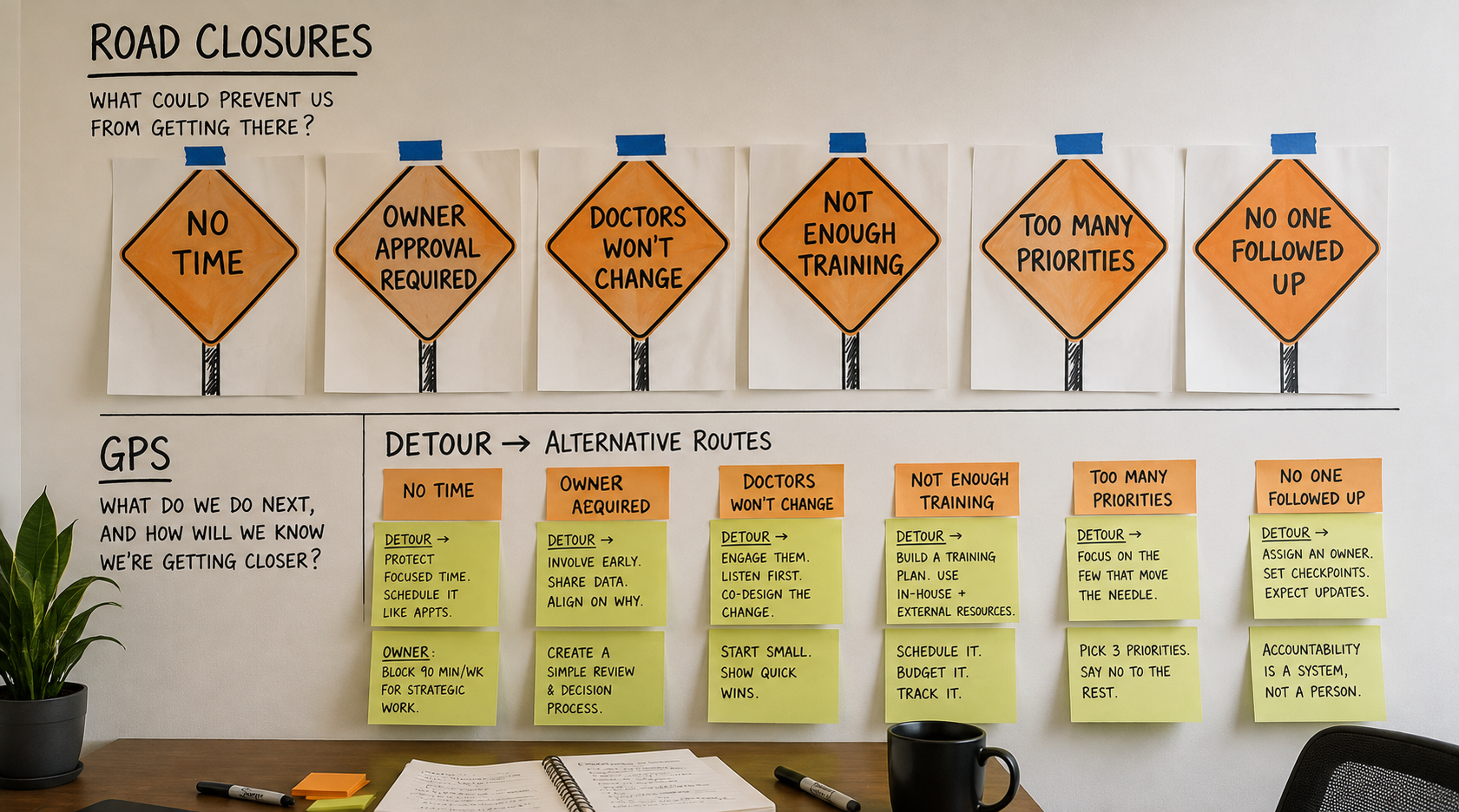
Exercise: DETOUR
- Take the road-closure signs you just created.
- Underneath each one, write the message you wish the road department had posted: DETOUR →
- If the obstacle is NO TIME, what’s the alternate route?
- If it’s DOCTORS WON’T CHANGE, what needs to happen before implementation?
- If it’s NO ONE FOLLOWED UP, who will own follow-up this time?
Don’t merely identify predictable barriers. Design the detour before you encounter them.
Exercise: The First 90 Days
- Go back to your bridges.
- What are the first things that need to be put in place to begin construction?
- Choose the actions that need to happen during the next 90 days. Assign an owner and a deadline to each.
Then identify how you will objectively measure whether you’re making progress.
Exercise: Recalculate Route
Before leaving the meeting, schedule the next get together. Ask, “What did we say we would do? Did we do it? What changed? What did we learn? Are we getting closer? Do we need to change the route?”
Conclusion
Strategic planning shouldn’t be something leadership does once every few years. Strategic thinking should become part of how leadership operates.
Veterinary hospitals are extraordinarily good at reacting to what’s happening right now. The phone rings. Someone calls out. A client complains. The schedule blows up. By 10:30 in the morning, everyone in leadership is working in the problems of the hospital rather than thinking about where the organization is going.
You don’t necessarily need more strategic planning.
Sometimes you just need to get everyone looking at the same destination, agree on where you’re starting, build a few bridges, anticipate the road closures—and start driving.